
From AI Curiosity to Contract Capability: A Q&A with Felipe Jaramillo, Stripe
- Cosmonauts Team
- Feb 9
- 4 min read

Updated: Feb 10
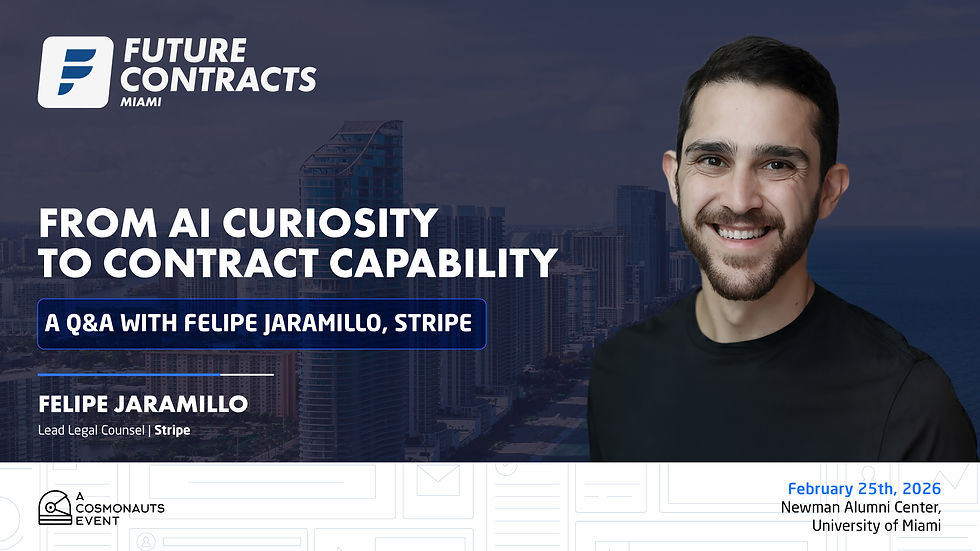
We’re kicking off the Future Contracts Miami Q&A series for 2026 with a conversation focused on how generative technology is reshaping contracts in practice.
In this first Q&A of the year, Felipe Jaramillo, Lead Legal Counsel at Stripe, shares how in-house legal teams are redesigning legal workflows, adopting AI responsibly, and evolving their role as strategic partners to the business.
Enjoy the interview below.
Do you think the legal industry is evolving quickly enough, or is it still resistant to meaningful change?
No, I don’t think the U.S. legal industry is resistant to meaningful change—but it often waits for other industries to move first. Over the past two to three years, momentum has picked up. In-house teams—especially those embedded in tech-forward companies—are adopting tools and redesigning workflows more quickly.
On technology, artificial intelligence (AI) has moved from curiosity to practical help. Common use cases include intake triage, first-pass review, clause suggestions, and summarization. These don’t replace judgment; they reduce time on repetitive work and surface risk faster. When paired with clear playbooks and structured data, the gains compound.
On operating models, I’m seeing more self-serve templates, clearer routing rules, and lightweight metrics to track cycle time and workload. Legal is collaborating earlier with the business and setting guardrails that let teams move without constant handoffs. That shift matters as much as any new tool.
From the outside it seems law firms are moving more slowly, and incentives are part of the reason. Fixed-fee or value-based work and shared data standards encourage change; hourly billing and bespoke processes don’t. Even so, many firms are experimenting, and client pressure is increasing.
So, overall I’m cautiously optimistic. The direction is right, the capabilities are real, and the last two to three years have shown that meaningful change is possible when technology and operating discipline meet.

What new roles or career paths have emerged within in-house legal teams as a result of innovations in the legal sector?
The main shift that I’ve seen is that many lawyers who have AI tools available now act as lightweight project managers and workflow designers. One of the benefits of AI is that it democratizes access to tools that deliver practical gains. I’ve seen more people design prompts and playbooks to fit their workflows.
I see this as the first, immediate result of innovation within the legal function. Previously, most technology changes for in-house teams required significant cross-functional collaboration with engineering and other partners. Now, with the right guardrails, in-house teams can self-serve much more work and continuously improve their processes. That puts more people in the driver’s seat as project managers for their own workflows.
Alongside this capability shift, new in-house roles are becoming more common: legal operations, legal engineer or technologist, contract operations analyst, knowledge manager, AI program manager, and data analyst. Many lawyers are informally doing parts of these jobs (prompt design, workflow mapping, change management, quality review, and basic metrics) without changing formal titles. The durable skills are product thinking, data literacy, and process design. This shift also raises expectations around governance and documentation so outputs are reliable and auditable. It’s early, but the direction is clear: more product-like work inside legal, supported by AI and data.
What developments in legal technology are you watching most closely over the next three years?
Like most in‑house teams, I’m watching artificial intelligence (AI)’s impact on legal technology. Over the next two to three years, the shift will be from discrete features to end‑to‑end workflows—how playbooks, contract lifecycle management (CLM), and knowledge systems work together.
The rise of agentic AI—the “digital colleague.” We’re moving from assistants you prompt to agents that act. Instead of asking for a summary, an agent can monitor a matter, detect a new filing, summarize it, cross‑reference strategy and playbooks, and draft a response for review. This reduces context switching. By 2026, tools could run multi‑agent flows where one agent researches, another drafts, and a third critiques.
“DMS 2.0” and embedded intelligence. Historical work product is the most valuable asset. Document management systems (DMS) are becoming active intelligence hubs. The winning approach is embedded—AI that lives in Word, Outlook, CLM, and the DMS—so you don’t “go to the AI”; it lives where the data lives.
Data sovereignty and governance. With the European Union (EU) AI Act taking full effect in August 2026, I’m watching “sovereign AI” models—private, high‑performance large language models (LLMs) deployed on‑premises or in localized clean rooms—to meet residency and privacy requirements. In‑house teams will increasingly expect clear provenance, evaluations, and access controls from vendors.
This is practical, not speculative: faster cycle times, better first drafts, and more self‑serve, with stronger controls. The next three years will be about making these systems reliable and auditable.
Join Felipe Jaramillo on stage in Miami
Felipe will be exploring these themes further at Future Contracts Miami, where he will join fellow in-house leaders on the panel “Harder, Better, Faster, Stronger: How Generative Technology Is Transforming Contracts.”
The session will focus on how legal teams are moving from AI pilots to scalable, workflow-led adoption across the contract lifecycle.
February 24 - Opening Reception | 6pm - 8pm
February 25 - Conference Day | 8.30am - 7.25pm
Newman Alumni Center, University of Miami


Comments