
Contracts in the Age of AI Vendors: Where Does Risk Actually Land?
- Cosmonauts Team
- Feb 18
- 5 min read

Updated: Feb 19
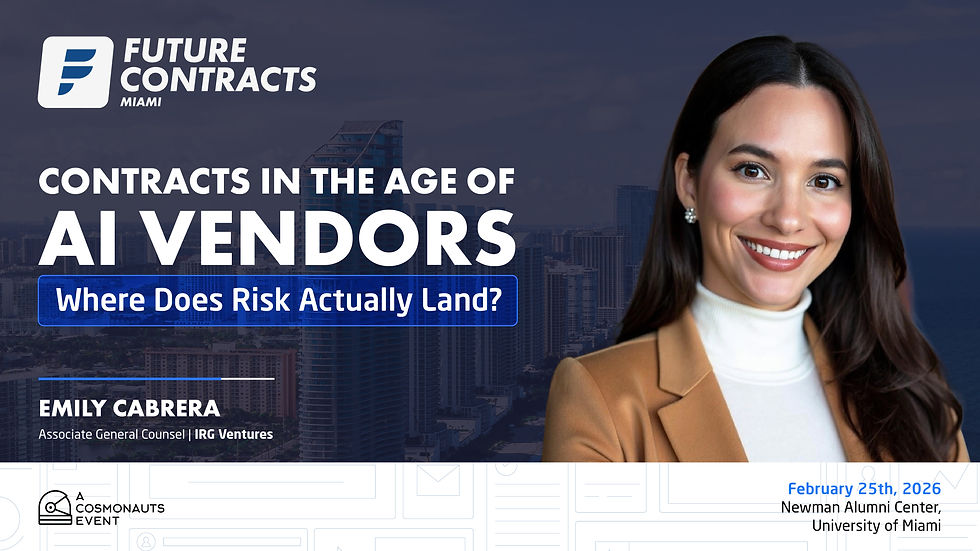
As organizations adopt AI vendors across layered ecosystems, accountability becomes increasingly complex. When something goes wrong, whether a data exposure, compliance breach, or operational failure, determining where risk actually lands is rarely straightforward.
In this Future Contracts Miami interview, Emily Cabrera, Associate General Counsel at IRG Ventures, shares a governance-first perspective on AI deployment, vendor risk allocation, and the evolving role of the in-house lawyer as enterprise risk architect.
Enjoy the interview below.
How important is continuous learning and adaptation for legal professionals in the age of digitalisation?
Continuous learning is foundational to credibility in today’s legal environment. In-house counsel are increasingly advising on AI deployment, multi-jurisdictional privacy frameworks, automated underwriting models, digital marketing ecosystems, and data monetization strategies. These are not static areas of law. They are evolving regulatory terrains that require intellectual agility.
In my own practice, I have had to design governance protocols for AI-assisted coding environments, evaluate vendor risk across multi-state regulatory frameworks, and structure data ownership between operating companies and a centralized analytics platform. None of those issues were contemplated in traditional legal education.
Adaptation, therefore, is not reactive. It is structural. The legal executive must be able to interpret emerging technology architectures and translate them into durable governance frameworks. The lawyer who resists technological literacy risks becoming strategically peripheral.

In your opinion, what are the most significant barriers to implementing digital solutions in legal practices?
The most significant barrier is misalignment between technology adoption and governance design. I have observed organizations procure sophisticated contract lifecycle management tools or AI review platforms without first clarifying intake processes, risk tolerance thresholds, or decision rights. The result is digitized ambiguity.
Another barrier is cultural - legal teams are conditioned to protect stability. Yet in fast-scaling environments, unmanaged technological adoption creates greater risk than structured experimentation.
In one instance, business teams were independently adopting AI drafting tools. Rather than prohibiting use, we implemented a tiered risk assessment framework, defined permissible use cases, and required vendor diligence for high-impact deployments. That shift from prohibition to architecture transformed the conversation from resistance to responsible enablement.
Technology succeeds when governance precedes enthusiasm.
What ethical or professional challenges do you foresee with increasing AI involvement in legal work?
The central challenge is the preservation of independent professional judgment.
AI systems can generate highly persuasive legal language. However, persuasion is not accuracy, and context is everything. The lawyer’s obligation of competence now includes understanding the operational limitations, data ingestion practices, and training biases of the tools they rely upon.
Confidentiality is equally critical. I have seen scenarios where teams were prepared to upload proprietary datasets into third-party AI platforms without fully understanding downstream data rights. Absent deliberate contractual safeguards, that exposure can have enterprise-level implications.
There is also a developmental concern. If emerging lawyers rely on automation before mastering analytical reasoning, the profession risks weakening its intellectual foundation. AI should elevate the lawyer’s judgment, not substitute for it.
How do you balance the push for innovation with the legal department’s traditional risk-averse culture?
I do not frame innovation as a departure from risk management. I frame it as its evolution.
In high-growth environments, innovation will occur regardless of legal endorsement. The question is whether legal will be architect or observer.
For example, when evaluating AI vendors across multiple portfolio entities, we established a structured review model that assessed data sensitivity, model autonomy, regulatory exposure, and contractual liability alignment. This allowed innovation to proceed, but within calibrated parameters.
Risk aversion without structure slows organizations. Structured governance enables them to move with precision.
What are the biggest pain points in contract workflows from your perspective as an in-house legal professional?
The most persistent pain points arise before drafting begins. Incomplete intake information, undefined commercial objectives, and lack of cross-functional ownership produce iterative negotiation cycles that appear legal in nature but are operational at their core.
In scaling environments, I have also observed post-execution risk — obligations that are not centrally tracked, renewal terms that auto-trigger without visibility, and data-sharing provisions that outlive their business utility.
Contracts are not merely instruments of record; they are ongoing operational commitments. Without integrated systems, organizations lose the strategic value embedded within them.
What has been your experience with contract lifecycle management tools, and what differentiates good ones from bad?
The distinction lies in whether the tool generates insight or merely storage.
Effective CLM platforms transform contractual language into structured data that can be queried, audited, and operationalized. They integrate with procurement and finance systems, create intake discipline, and offer transparency into bottlenecks.
I have seen implementations succeed when the tool was paired with process redesign — standardized templates, defined approval matrices, and reporting dashboards aligned with executive oversight.
By contrast, when CLMs are treated as document repositories without governance alignment, adoption falters and value dissipates.
In your experience, what risks arise when automated contract tools are used without sufficient oversight?
Automation magnifies both efficiency and exposure. Without calibrated clause libraries and clearly defined fallback positions, automated tools can replicate outdated indemnity structures or inconsistent limitation-of-liability provisions across dozens of agreements in a matter of weeks.
In regulated industries, where contractual language intersects directly with statutory obligations, such replication can create systemic vulnerability. Human oversight should not impede velocity. It should define the perimeter within which automation operates safely.
How do you imagine the role of the in-house lawyer changing over the next decade?
The in-house lawyer will increasingly operate as an enterprise risk architect. Beyond drafting and negotiation, the role now includes data governance, AI deployment oversight, cross-entity IP structuring, and strategic regulatory positioning.
In my experience overseeing multiple operating entities within a venture structure, legal’s influence has expanded from document review to infrastructure design — determining how data flows, how intellectual property is allocated, and how technology partnerships are structured for long-term defensibility.
Future in-house counsel will require financial literacy, systems thinking, technological fluency, and the ability to communicate risk in executive terms. Law schools traditionally emphasize doctrine. The next decade will demand operational leadership.
What key insights do you want attendees to leave with after your speech at Future Contracts Miami?
First, digital transformation in contract management is not a question of adoption — it is a question of architecture.
Second, contracts should be viewed as data-rich strategic assets. Organizations that harness contractual data for reporting, forecasting, and compliance oversight will gain measurable competitive advantage.
Third, innovation and governance are not adversaries. When governance is thoughtfully designed, it accelerates rather than constrains progress.
The future of contracts will not diminish the lawyer’s role. It will elevate those who are prepared to lead at the systems level.
Join Emily on Stage in Miami
Emily will join the panel “Contracts in the Age of AI Vendors: Where Does Risk Actually Land?” at Future Contracts Miami.
The discussion will explore how in-house legal teams allocate AI risk defensibly across vendors, procurement, compliance, and business units, without slowing innovation.
February 24 - Opening Reception | 6pm - 8pm
February 25 - Conference Day | 8.30am - 7.25pm
Newman Alumni Center, University of Miami


Comments